
10 Key Factors to Consider When Building a Cold Storage Facility
Building a cold storage facility requires careful planning, specialised construction knowledge, and a clear understanding of temperature-controlled environments. Whether the facility is designed for frozen food, fresh produce, pharmaceuticals, or other temperature-sensitive products, every construction decision can affect energy efficiency, product quality, operational costs, and long-term performance. 10 Key Factors to Consider When Building a Cold Storage Facility
Unlike conventional warehouses, cold storage facilities must maintain specific temperature and humidity conditions while preventing heat transfer, condensation, and structural deterioration. Choosing the right site, insulation materials, refrigeration systems, and building layout is essential to achieving a reliable and efficient facility.
Before starting a cold storage construction project, businesses should evaluate several important factors. Here are ten key considerations to help guide the planning, design, and construction process.
1. Site Selection and Location
Selecting the right site is one of the first decisions to make when building a cold storage facility. The location can influence construction costs, transportation efficiency, utility availability, and future business growth.
Ideally, a cold storage facility should be positioned near major transport routes, suppliers, distribution centres, or end customers. For businesses handling perishable goods, reducing transportation time can help maintain product quality and improve supply chain efficiency.
Evaluate Site Conditions and Accessibility
Before purchasing or developing a property, assess soil conditions, drainage, flood risk, ground stability, and access for heavy vehicles. The site should accommodate loading docks, truck manoeuvring areas, parking, and potential future expansion.
It is also important to confirm that electricity, water, telecommunications, and other required utilities are available. Refrigeration systems can have substantial electrical demands, so the capacity and cost of connecting to the power network should be investigated early.
2. Insulation and Thermal Performance
Insulation is a fundamental component of cold storage construction because it limits heat transfer between the refrigerated interior and the external environment. Poor insulation can increase refrigeration demand, raise operating costs, and make it difficult to maintain consistent temperatures.
Insulated wall panels, roof panels, and floor systems should be selected according to the facility’s intended operating temperatures, building design, and environmental conditions.
Choose Appropriate Insulation Materials
Common options include insulated sandwich panels with suitable foam cores, selected according to thermal performance, fire requirements, durability, and installation conditions. Panel thickness and insulation specifications should reflect whether the facility will store chilled products or operate as a deep-freeze warehouse.
Thermal bridging must also be addressed. This occurs when heat travels through conductive elements such as structural connections, creating localised areas of heat gain and potential condensation.
A continuous insulation strategy, properly sealed joints, and carefully designed connections help improve thermal performance and reduce unnecessary energy consumption.
3. Refrigeration System Design
The refrigeration system determines the facility’s ability to maintain the required storage conditions. Selecting the appropriate equipment requires an understanding of storage temperatures, product types, building dimensions, operating schedules, and expected stock movements.
Refrigeration capacity should be calculated based on the total cooling load rather than floor area alone. Factors such as heat entering through the building envelope, incoming product temperatures, lighting, equipment, people, and door openings all contribute to demand.
Prioritise Efficiency and Reliability
Work with qualified refrigeration specialists to assess suitable equipment, refrigerants, controls, and system configurations. Energy-efficient compressors, appropriately sized evaporators, variable-speed equipment, and effective control systems can improve performance when correctly designed.
Maintenance access and equipment redundancy should also be considered. Depending on the facility’s purpose, backup capacity or contingency arrangements may be necessary to protect valuable or temperature-sensitive inventory during equipment failures.
4. Temperature and Humidity Requirements
Different products require different storage conditions. Frozen foods, fresh fruit, vegetables, meat, seafood, and pharmaceutical products may have distinct temperature, humidity, and monitoring requirements.
These requirements should be established before the facility layout and refrigeration system are finalised. A clear understanding of the stored products helps determine the number of temperature zones, the required cooling capacity, and the appropriate monitoring equipment.
Consider Multiple Temperature Zones
Some operations benefit from separate chilled, frozen, and ambient storage areas. Dividing the facility into zones allows each area to maintain suitable conditions without unnecessarily cooling the entire building to the lowest required temperature.
Temperature monitoring systems should provide reliable readings and alerts when conditions move outside approved limits. For regulated products, monitoring, calibration, recordkeeping, and alarm procedures may need to meet specific industry requirements.
5. Flooring and Structural Design
Cold storage floors must withstand heavy loads, frequent forklift movements, and prolonged exposure to low temperatures. Flooring design is particularly important in freezer facilities, where inadequate insulation or moisture control can contribute to frost heave beneath the slab.
Frost heave occurs when freezing ground moisture expands and causes movement that can damage floor slabs and affect building stability.
Plan for Load Capacity and Ground Protection
A suitable flooring system may include a prepared sub-base, moisture barriers, insulation, a reinforced concrete slab, and an appropriate wearing surface. The exact configuration depends on soil conditions, storage temperatures, racking loads, and operational requirements.
Some freezer applications require engineered subfloor heating or ventilation systems to help prevent ground freezing. Structural engineers should assess slab thickness, reinforcement, joint detailing, and concentrated loads from storage racks and material-handling equipment.
6. Energy Efficiency and Operating Costs
Energy consumption is a major consideration when constructing a cold storage facility. Refrigeration equipment, lighting, ventilation, and other building systems can contribute significantly to ongoing operating expenses.
Although energy-efficient features may increase initial construction costs, they can deliver long-term savings when selected and implemented appropriately.
Reduce Energy Loss Through Smart Design
Consider high-performance insulation, airtight construction, energy-efficient lighting, automatic door controls, and refrigeration systems designed for the actual cooling load. Heat recovery may also be suitable where recovered heat can serve useful building or process requirements.
Building orientation, loading dock arrangements, and traffic flow can influence heat gain and door-opening frequency. Energy monitoring systems can help operators identify inefficiencies and adjust equipment settings.
A whole-of-life cost assessment is often more useful than comparing construction prices alone because it considers capital expenditure, energy consumption, maintenance, and equipment replacement.
7. Building Layout and Operational Workflow
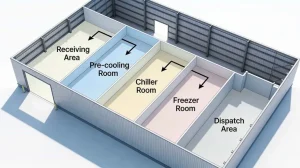
An efficient layout helps minimise product handling, reduce unnecessary travel, and maintain temperature control during daily operations. Poorly planned traffic flow can create bottlenecks, increase labour costs, and allow warm air to enter refrigerated areas.
The design should reflect how products arrive, are inspected, stored, picked, packed, and dispatched.
Optimise Storage Capacity and Material Handling
Consider aisle widths, racking configurations, forklift movements, automated storage systems, picking areas, and separation between pedestrian and vehicle routes. High-bay racking can increase storage capacity, but it must be coordinated with structural requirements, refrigeration airflow, fire protection, and retrieval methods.
Loading docks and staging areas should also be designed to limit exposure of refrigerated spaces to external conditions. Where appropriate, dock shelters, insulated doors, and temperature-controlled transfer areas can help maintain product integrity.
8. Moisture Control, Condensation, and Air Sealing
Moisture management is essential in cold storage construction. Warm, humid air entering a cold environment can cause condensation, frost formation, and ice accumulation. Over time, moisture entering building assemblies can also contribute to insulation deterioration and corrosion.
Install Effective Vapour Barriers and Seals
The building envelope should incorporate appropriately designed vapour-control layers, airtight joints, and sealed penetrations. Their location and specification must account for the direction of vapour movement, climate conditions, and temperature differences across the building envelope.
Doors, service penetrations, panel joints, and transitions between walls, roofs, and floors require particular attention. Airlocks or high-speed doors may be beneficial in areas with frequent access.
Good moisture control starts during design and depends on careful installation and quality inspections throughout construction.
9. Safety, Building Codes, and Regulatory Compliance
Cold storage facilities must meet applicable building, structural, fire safety, electrical, workplace safety, and environmental requirements. Additional obligations may apply depending on the products stored, refrigeration technology, and facility operations.
Compliance should be considered at the beginning of the project rather than left until construction is nearly complete.
Coordinate Design and Safety Requirements
Engage appropriately qualified professionals to assess fire protection, emergency exits, electrical installations, refrigeration plant safety, and worker access. Refrigerant selection and system design should account for relevant safety requirements and environmental obligations.
In Australia, projects may need to comply with applicable National Construction Code requirements, relevant Australian Standards, state or territory regulations, and local planning approvals. Requirements vary by project, so confirm the applicable provisions with building surveyors, engineers, and relevant authorities.
Operational safety should also influence the design, including slip-resistant flooring, adequate lighting, emergency communication, safe pedestrian routes, and procedures for working in low-temperature environments.
10. Future Expansion and Long-Term Maintenance
A cold storage facility should be designed to support the business beyond its immediate requirements. Changes in customer demand, product ranges, technology, and distribution strategies may increase storage capacity or alter operational needs.
Planning for future growth can reduce the cost and disruption of later modifications.
Build Flexibility Into the Facility
Where practical, consider modular construction, adaptable storage zones, space for additional refrigeration equipment, and provisions for future electrical capacity. Structural layouts and site access should allow for potential extensions without disrupting existing operations.
Maintenance requirements are equally important. Refrigeration plant, evaporators, electrical equipment, doors, drainage systems, and monitoring devices should remain accessible for inspection and servicing.
A preventive maintenance plan, supported by equipment documentation and performance monitoring, can reduce unplanned downtime and extend the service life of critical systems.
Conclusion
Building a successful cold storage facility involves much more than constructing an insulated warehouse. Site selection, thermal performance, refrigeration design, temperature requirements, structural integrity, energy efficiency, operational workflow, moisture control, compliance, and future expansion must all be considered together.
Making informed decisions during the planning and design stages can help businesses avoid costly construction changes, improve energy performance, protect stored products, and create a facility that supports efficient daily operations.
By working with experienced cold storage designers, builders, refrigeration specialists, and engineers, businesses can develop a facility that meets their operational requirements while balancing upfront investment with long-term performance. A well-planned cold storage construction project provides a reliable foundation for product quality, supply chain efficiency, and sustainable business growth.
Recent Comments