
Comparing Metal, Concrete, and Panel Walls for Cold Storage Use
Cold storage facilities depend heavily on wall construction to maintain precise internal temperatures and minimise energy consumption. The choice between metal, concrete, and insulated panel wall systems significantly impacts thermal performance, operational efficiency, construction costs, and long-term durability. Comparing Metal, Concrete, and Panel Walls for Cold Storage Use
Each wall type has distinct advantages and limitations, and selecting the right system depends on the facility’s temperature requirements, budget, and operational goals. This article compares metal, concrete, and panel wall systems for cold storage use to help determine the most effective solution.
Why Wall Type Matters in Cold Storage Construction
Cold storage buildings operate under strict temperature control, often ranging from chilled environments above 0°C to deep freeze conditions below -25°C. Walls are the primary barrier between the controlled interior environment and external heat sources.
The Role of Walls in Thermal Performance
Walls influence:
Heat transfer rates
Energy consumption of refrigeration systems
Moisture and condensation control
Structural durability under temperature stress
Even small differences in wall construction can significantly affect operating costs over time.
Metal Walls in Cold Storage Facilities
Metal wall systems are often used in industrial environments due to their strength and durability. However, metal alone is not sufficient insulation for cold storage without additional layers.
Advantages of Metal Wall Systems
Metal walls, typically made from steel or aluminium, offer several benefits:
High structural strength and impact resistance
Long service life with proper coating and maintenance
Resistance to pests and external damage
Suitable for harsh industrial environments
Metal is often used as the outer protective layer in composite systems.
Limitations of Metal Walls
Despite their strength, metal walls have significant drawbacks in cold storage applications:
High thermal conductivity leads to heat transfer
Requires additional insulation layers for efficiency
Susceptible to condensation if not properly insulated
Can contribute to thermal bridging
Metal alone is not energy efficient, so it is rarely used as a standalone cold storage wall material.
Concrete Walls in Cold Storage Buildings
Concrete is a traditional building material widely used in industrial construction. In cold storage facilities, it is often used for structural frameworks or full wall systems with insulation added separately.
Advantages of Concrete Walls
Concrete offers strong structural benefits:
Excellent load-bearing capacity
High durability and fire resistance
Good resistance to physical damage
Long lifespan with minimal maintenance
Concrete is particularly useful in large-scale facilities requiring robust structural support.
Limitations of Concrete Walls
However, concrete has major limitations in cold storage environments:
Poor natural insulation properties
High thermal mass can delay temperature control
Requires significant insulation upgrades for efficiency
Prone to moisture absorption and condensation issues
Without proper insulation layers, concrete walls can lead to high energy consumption due to heat transfer.
Insulated Panel Walls (Sandwich Panels)
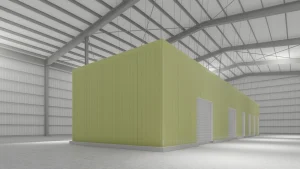
Insulated panel systems, often called sandwich panels, are the most commonly used wall solution in modern cold storage construction. They consist of an insulation core sandwiched between two metal facings.
Common core materials include PIR (polyisocyanurate), PUR (polyurethane), EPS (expanded polystyrene), and mineral wool.
Advantages of Panel Wall Systems
Insulated panels offer several key benefits:
High thermal efficiency due to advanced insulation cores
Fast and cost-effective installation
Lightweight construction reduces structural load
Airtight joint systems reduce energy loss
Modular design allows easy expansion
These advantages make panel systems highly suitable for modern cold storage facilities.
Limitations of Panel Walls
Despite their efficiency, panel systems have some limitations:
Require careful installation to ensure airtight sealing
Can be vulnerable to damage if not properly protected
Performance depends heavily on panel quality and joint integrity
Some fire rating limitations depending on insulation type
However, these limitations are generally manageable with proper design and installation practices.
Thermal Performance Comparison
Energy efficiency is the most important factor in cold storage wall selection.
Metal Walls and Thermal Efficiency
Metal walls alone perform poorly in insulation due to high thermal conductivity. Heat passes through metal quickly, making them unsuitable without added insulation layers.
Concrete Walls and Heat Retention
Concrete has high thermal mass, meaning it absorbs and stores heat. While this can help stabilize temperatures in some environments, it is not ideal for cold storage because:
It delays cooling response times
It increases energy required for temperature control
Panel Walls and Insulation Efficiency
Insulated panel systems provide the best thermal performance:
PIR panels offer very low thermal conductivity
Multi-layer construction minimises heat transfer
Airtight joints reduce air leakage
Overall, panel walls are the most energy-efficient option.
Energy Consumption and Operational Costs
Wall material choice directly impacts refrigeration system workload.
Metal and Concrete Energy Impact
Both metal and concrete walls increase energy demand unless heavily insulated:
Higher cooling loads
Increased electricity consumption
Greater strain on refrigeration systems
This leads to higher long-term operating costs.
Panel Systems and Energy Savings
Insulated panel systems reduce energy consumption by:
Minimising heat gain
Maintaining stable internal temperatures
Reducing compressor workload
Over time, this results in significant operational savings.
Moisture Control and Condensation Risk
Moisture is a critical issue in cold storage environments.
Metal Walls and Condensation
Metal surfaces are prone to condensation because they rapidly transfer temperature changes. Without insulation, this leads to:
Water buildup
Corrosion risks
Ice formation
Concrete Walls and Moisture Absorption
Concrete can absorb moisture, leading to:
Structural weakening over time
Reduced insulation performance
Increased risk of mould in poorly controlled environments
Panel Walls and Moisture Resistance
Insulated panels perform best in moisture control:
Closed-cell insulation resists water absorption
Airtight joints prevent humid air infiltration
Reduced condensation risk compared to traditional materials
Installation and Construction Efficiency
Construction speed and ease of installation are important in industrial projects.
Metal and Concrete Construction Time
Metal and concrete systems require:
Longer construction timelines
More labour-intensive installation
Additional insulation layers
Panel Wall Installation Advantages
Panel systems offer:
Fast modular installation
Reduced labour requirements
Minimal on-site construction work
Easy expansion or modification
This makes them highly efficient for time-sensitive projects.
Durability and Maintenance Considerations
Long-term performance is essential for cold storage facilities.
Metal Wall Durability
Metal is highly durable but requires:
Protective coatings to prevent corrosion
Regular maintenance in harsh environments
Concrete Wall Longevity
Concrete offers long structural life but may:
Crack over time under temperature stress
Require repairs to insulation systems
Panel System Maintenance
Panel walls require:
Proper sealing maintenance
Occasional joint inspection
Protection from physical damage
When well-maintained, they provide long service life with high efficiency.
Which Wall System Is Best for Cold Storage?
Each wall type serves different needs.
Metal Walls
Best suited for:
Structural frameworks
Protective exterior layers
Industrial environments requiring impact resistance
Not suitable as standalone insulation walls.
Concrete Walls
Best suited for:
Heavy-duty structural support
Large industrial facilities
Fire-resistant environments
Requires additional insulation for energy efficiency.
Insulated Panel Walls
Best suited for:
Modern cold storage warehouses
Food and pharmaceutical storage
Energy-efficient refrigeration systems
Fast-deployment facilities
Overall, panel systems provide the best balance of efficiency, cost, and performance.
Conclusion
When comparing metal, concrete, and insulated panel walls for cold storage use, each material plays a different role in construction. Metal provides strength, concrete offers structural durability, and insulated panels deliver superior thermal performance.
However, in terms of energy efficiency, installation speed, and operational cost savings, insulated panel walls clearly outperform traditional metal and concrete systems. For modern cold storage facilities focused on efficiency and sustainability, panel-based construction remains the most effective and widely adopted solution.
Recent Comments