
Cold Room Door Insulation Basics
Cold room doors are one of the most important components in any refrigerated or frozen storage environment. While refrigeration systems are responsible for generating cold temperatures, it is the insulation in the doors that ensures those temperatures remain stable and efficient. Without proper insulation, cold air escapes, warm air enters, and energy costs rise significantly.
Understanding the basics of cold room door insulation helps explain how these systems maintain performance, reduce energy consumption, and protect temperature-sensitive goods. This article breaks down the core principles, materials, and design features that make cold room door insulation effective.
Why Cold Room Door Insulation Matters
Cold room doors are constantly exposed to temperature differences between the inside and outside environment. This creates a constant pressure for heat exchange, which must be controlled through insulation.
Preventing Heat Transfer
The main purpose of insulation is to reduce heat transfer. Heat naturally moves from warmer areas to cooler ones. Without insulation, warm external air would quickly enter the cold room, raising internal temperatures and compromising stored goods. Insulated doors act as a thermal barrier, slowing this process significantly.
Reducing Energy Consumption
When cold air escapes or warm air enters, refrigeration systems must work harder to maintain the desired temperature. This increases energy consumption and operational costs. Proper door insulation reduces this load, helping facilities operate more efficiently and sustainably.
Maintaining Product Quality
Industries such as food storage, pharmaceuticals, and logistics rely on precise temperature control. Even small fluctuations can affect product safety and shelf life. Insulated cold room doors help ensure stable conditions, protecting sensitive inventory.
Core Principles of Insulation in Cold Room Doors
Cold room door insulation is based on controlling how heat moves through materials. This is achieved using specialized insulating cores and sealed construction techniques.
Thermal Resistance (R-Value)
The effectiveness of insulation is often measured using R-value, which represents resistance to heat flow. Higher R-values indicate better insulation performance. Cold room doors with high R-value cores are more effective at maintaining stable internal temperatures.
Heat Bridging Prevention
Heat bridging occurs when conductive materials like metal allow heat to pass through insulated layers. To prevent this, cold room doors use thermal breaks that interrupt the path of heat transfer, improving overall efficiency.
Airtight Sealing
Even the best insulation materials are ineffective if air leaks occur. Airtight seals around the edges of the door ensure that cold air stays inside and warm air stays outside. This is essential for maintaining stable conditions.
Common Insulation Materials Used in Cold Room Doors
The insulation core is the most important part of a cold room door. Different materials offer different levels of thermal efficiency, cost, and durability.
Polyurethane Foam (PU)
Polyurethane foam is one of the most widely used insulation materials in cold room doors. It is injected into the door cavity where it expands and hardens into a dense, closed-cell structure.
This structure traps gas bubbles, which significantly reduces heat transfer. PU foam provides excellent thermal performance and is lightweight, making it ideal for both walk-in coolers and large industrial cold storage doors.
Polyisocyanurate (PIR)
Polyisocyanurate foam is similar to polyurethane but offers improved fire resistance and slightly better thermal performance. It is commonly used in high-specification cold storage environments where safety and efficiency are top priorities.
PIR maintains its insulating properties even under extreme temperature conditions, making it suitable for freezer rooms and long-term storage facilities.
Expanded and Extruded Polystyrene (EPS and XPS)
EPS and XPS are cost-effective insulation materials used in moderate cold storage applications.
EPS is lightweight and affordable but offers lower thermal resistance. XPS is denser, stronger, and more moisture-resistant, making it a better option for environments where durability and moderate insulation are required.
Structural Components Supporting Insulation
Insulation alone does not guarantee performance. Cold room doors rely on structural elements that protect and enhance insulation effectiveness.
Outer and Inner Metal Skins
Cold room doors are typically constructed with outer and inner skins made of materials such as stainless steel or galvanized steel. These layers protect the insulation core and provide structural strength.
Stainless steel is preferred in hygiene-sensitive environments due to its corrosion resistance and ease of cleaning. Galvanized steel is more cost-effective and widely used in commercial cold storage systems.
Thermal Break Layers
Thermal breaks are insulating materials placed between metal components to prevent heat conduction. Without thermal breaks, metal frames could act as pathways for heat transfer, reducing the effectiveness of insulation.
Reinforced Door Frames
Cold room doors are heavy due to their insulation cores. Reinforced frames ensure that the door remains aligned and sealed properly over time, preventing air leaks and mechanical failure.
Sealing Systems in Cold Room Door Insulation
Seals are critical to ensuring that insulation works effectively. Even small gaps can lead to significant energy loss.
Rubber Gaskets
Rubber gaskets are installed around the edges of the door to create a tight seal when closed. They compress to fill gaps, preventing air leakage and maintaining internal temperature stability.
High-quality gaskets remain flexible even in freezing conditions, ensuring consistent performance over time.
Magnetic Seals
Magnetic sealing systems provide uniform pressure along the door edges. This ensures a more consistent airtight seal compared to traditional gasket-only systems, especially in high-traffic environments.
Anti-Frost Heating Elements
In freezer environments, moisture can freeze around door edges and compromise sealing. Heating elements are used to prevent ice formation, ensuring the door remains easy to open and properly sealed.
Types of Cold Room Door Insulation Systems
Different cold storage applications require different insulation approaches depending on usage, temperature range, and frequency of access.
Hinged Insulated Doors
Hinged doors are the most common type used in small to medium cold rooms. They offer excellent sealing performance and are ideal for low to moderate traffic environments.
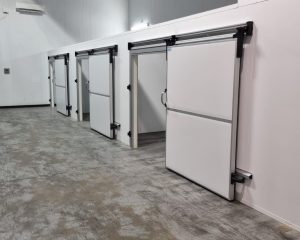
Sliding Insulated Doors
Sliding doors are used in larger facilities where space efficiency is important. They reduce airflow disruption when opened and are commonly found in warehouses and distribution centers.
High-Speed Insulated Doors
High-speed doors are designed for environments with frequent access. They open and close quickly, minimizing temperature loss and improving operational efficiency.
Key Factors That Affect Insulation Performance
Several factors determine how well a cold room door insulation system performs in real-world conditions.
Material Density and Composition
The density and structure of insulation materials affect how well they resist heat transfer. Closed-cell foams like PU and PIR offer superior performance due to trapped gas pockets.
Door Thickness
Thicker insulation layers generally provide better thermal resistance. However, design balance is required to maintain usability and structural strength.
Installation Quality
Even high-quality materials can fail if installation is poor. Gaps, misalignment, or weak sealing can significantly reduce insulation effectiveness.
Conclusion
Cold room door insulation is a carefully engineered system that combines advanced materials, structural design, and sealing technologies to maintain stable temperatures. From polyurethane and PIR foam cores to airtight gaskets and thermal breaks, every component plays a vital role.
Understanding the basics of insulation helps explain why cold room doors are essential for energy efficiency, product safety, and operational reliability. Properly designed insulation systems not only reduce costs but also ensure long-term performance in demanding cold storage environments.
Recent Comments