
How Cold Storage Doors Are Built
Cold storage doors are highly engineered systems designed to maintain strict temperature control in refrigerated and frozen environments. Unlike standard commercial doors, they must prevent heat transfer, resist moisture and frost, withstand frequent use, and support hygiene standards in industries such as food processing, pharmaceuticals, and logistics.
Understanding how cold storage doors are built reveals why they are essential components in cold chain infrastructure. Their construction involves multiple layers, specialized materials, and precision engineering to ensure consistent performance under demanding conditions.
The Design Purpose Behind Cold Storage Doors
Cold storage doors are built with a clear objective: to maintain a stable internal environment while allowing controlled access.
Temperature Separation Between Environments
The primary function of a cold storage door is to separate two temperature zones. Inside the cold room, temperatures may range from chilled conditions above freezing to deep-freeze environments. Outside, ambient temperatures fluctuate constantly. The door must act as a barrier that minimizes heat exchange between these zones.
Energy Efficiency Requirements
Every time a door opens, cold air can escape and warm air can enter. Without proper construction, refrigeration systems must work harder to restore temperature balance. Well-built cold storage doors reduce this load, helping facilities lower energy costs and improve efficiency.
Operational and Hygiene Demands
Cold storage doors are used in environments where cleanliness and safety are critical. Food processing plants and pharmaceutical storage facilities require doors that are easy to sanitize, resistant to contamination, and capable of maintaining airtight seals even under frequent use.
Main Structural Layers of Cold Storage Doors
Cold storage doors are built using a layered system that combines insulation, structural strength, and protective surfaces.
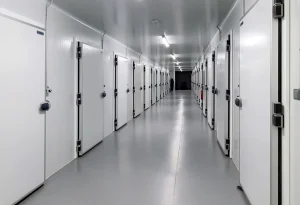
Outer Skin: Protective Metal Layer
The outer layer of a cold storage door is typically made from stainless steel or galvanized steel. This layer provides durability and protection against physical damage, corrosion, and environmental exposure.
Stainless steel is commonly used in hygienic environments because it resists rust and is easy to clean. Galvanized steel, coated with zinc and often finished with powder coating, is a more cost-effective alternative used in commercial and industrial applications.
Core Insulation Layer
The core of the door is the most important component in terms of thermal performance. This layer is filled with insulating materials such as polyurethane foam, polyisocyanurate foam, or polystyrene.
These materials are injected or placed within the door cavity and then expanded or compacted to form a dense, airtight barrier. The insulation core slows down heat transfer, ensuring the internal temperature remains stable.
Inner Skin: Interior Protection Layer
The inner surface of the door mirrors the outer skin but is optimized for cold storage conditions. It must resist condensation, moisture buildup, and frequent cleaning. It also plays a role in maintaining hygiene standards within the cold room environment.
Insulation Materials Used in Construction
The choice of insulation material significantly affects how the door performs in real-world conditions.
Polyurethane Foam (PU)
Polyurethane foam is one of the most commonly used materials in cold storage door construction. It is injected as a liquid into the door panel, where it expands to fill all internal spaces.
Its closed-cell structure traps gas bubbles, reducing heat transfer and providing excellent thermal insulation. PU foam is lightweight, durable, and widely used in both chilled and frozen storage applications.
Polyisocyanurate (PIR)
Polyisocyanurate foam is similar to polyurethane but offers improved fire resistance and slightly better thermal efficiency. It is often used in high-performance cold storage facilities where safety and energy efficiency are top priorities.
PIR maintains its structure under extreme temperature conditions, making it suitable for freezer rooms and large-scale industrial cold storage systems.
Expanded and Extruded Polystyrene (EPS and XPS)
EPS and XPS are cost-effective insulation options used in less demanding cold storage environments. EPS is lightweight and affordable, while XPS offers improved strength and moisture resistance.
These materials are typically used in commercial refrigeration or moderate-temperature cold rooms.
Structural Framework and Reinforcement
Cold storage doors must support heavy insulation materials while maintaining smooth operation and long-term durability.
Reinforced Door Frames
Door frames are constructed from strong materials such as steel or aluminum alloys. They are designed to support the weight of the insulated panel while maintaining alignment to ensure airtight sealing.
Proper reinforcement prevents warping or misalignment caused by repeated opening and closing.
Internal Support Structures
Inside the door, additional reinforcement structures may be used to enhance rigidity. These supports ensure that the door maintains its shape over time, even under extreme temperature fluctuations.
Thermal Break Integration
Thermal breaks are incorporated into the structure to prevent heat transfer through metal components. Without these breaks, metal frames could act as bridges for heat, reducing the effectiveness of insulation.
Sealing Systems and Air Tightness
A well-built cold storage door relies heavily on sealing systems to prevent air leakage.
Rubber Gaskets
Rubber gaskets are installed along the edges of the door to create a tight seal when closed. These gaskets compress against the frame, blocking air exchange and maintaining internal temperature stability.
High-quality gaskets remain flexible in freezing conditions, ensuring long-term performance.
Magnetic Sealing Systems
Magnetic seals are used in modern cold storage door designs to enhance airtight performance. They apply uniform pressure along the door edges, reducing gaps and improving insulation efficiency.
Anti-Frost Heating Systems
In freezer environments, frost can form around door edges, affecting seal quality. Heating elements are built into the frame to prevent ice buildup, ensuring smooth operation and consistent sealing.
Types of Cold Storage Doors and Their Construction Differences
Different cold storage applications require different door designs, each with unique construction methods.
Hinged Cold Storage Doors
Hinged doors are the most common type and are typically used in smaller cold rooms. They are constructed with thick insulation panels mounted on reinforced hinges that ensure a tight seal when closed.
Sliding Cold Storage Doors
Sliding doors are built for larger industrial environments where space efficiency is important. They move along a track system and are designed to minimize air disruption during operation.
High-Speed Roll-Up Doors
High-speed doors are designed for environments with frequent access. They are constructed with lightweight insulated panels and fast-opening mechanisms to reduce temperature loss.
Manufacturing Process of Cold Storage Doors
The construction of cold storage doors involves several precise manufacturing steps.
Panel Assembly
The outer and inner metal skins are first prepared and shaped. These panels are aligned to create a cavity for the insulation material.
Foam Injection or Filling
Insulation materials such as polyurethane foam are injected into the cavity. The foam expands to fill the entire space, bonding with the metal surfaces.
Curing and Hardening
Once filled, the door panel is left to cure. During this process, the foam hardens and stabilizes, forming a rigid insulation core.
Finishing and Hardware Installation
Finally, sealing systems, hinges, frames, and protective coatings are added. The door is then tested for airtight performance and durability.
Conclusion
Cold storage doors are carefully engineered products built from multiple layers of insulation, reinforced structural components, and precision sealing systems. From polyurethane foam cores to stainless steel skins and thermal breaks, every part of the construction process contributes to performance.
Understanding how cold storage doors are built highlights the importance of material selection, manufacturing precision, and design integration. These doors are not simple entry points—they are essential systems that ensure energy efficiency, product safety, and reliable cold chain operation.
Recent Comments