
Flooring and Racking Equipment for Commercial Cold Storage
Commercial cold storage facilities are designed to preserve perishable goods under tightly controlled temperature conditions. While refrigeration systems often receive the most attention, flooring and racking equipment are equally critical to the performance, safety, and longevity of the facility. Poorly selected materials can lead to structural damage, safety hazards, product loss, and expensive repairs.
In cold environments where temperatures can drop well below freezing, flooring and racking systems must withstand extreme conditions, heavy loads, moisture exposure, and constant traffic from forklifts and pallet jacks. This article explores the essential considerations, materials, and equipment options for flooring and racking in commercial cold storage facilities.
The Importance of Proper Flooring in Cold Storage
Cold storage flooring must perform under conditions that differ significantly from standard warehouse environments. Freezing temperatures, thermal shock, condensation, and heavy mechanical loads create unique challenges.
Key functions of cold storage flooring include:
Supporting heavy racking and pallet loads
Resisting cracking from temperature fluctuations
Preventing moisture penetration and ice formation
Providing slip resistance for worker safety
Maintaining insulation to prevent frost heave
Improper flooring design can result in structural movement, slab cracking, and long-term operational disruptions.
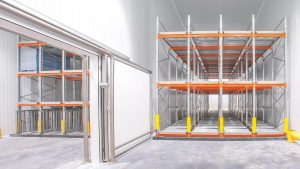
Key Flooring Requirements for Commercial Cold Storage
Before selecting materials, facility planners must consider performance requirements specific to cold environments.
1. Thermal Insulation
Cold storage floors must include proper insulation layers beneath the concrete slab. Without insulation, subgrade soil can freeze and expand, causing frost heave that damages the slab.
Common insulation materials include:
Extruded polystyrene (XPS) boards
High-density rigid foam insulation
These materials are installed beneath the slab to maintain temperature separation between the freezer interior and the ground below.
2. Vapor Barriers
Moisture migration is a major risk in cold storage facilities. Vapor barriers prevent ground moisture from entering the slab, where it could freeze and cause cracking or surface failure.
High-quality polyethylene vapor barriers are typically installed below the insulation layer to provide moisture protection.
3. High-Strength Concrete Slabs
Cold storage floors must support:
Heavy pallet loads
High-density racking systems
Forklift traffic
Impact from material handling equipment
Reinforced concrete slabs with high compressive strength are essential. Many facilities use steel-reinforced or fiber-reinforced concrete to enhance durability and reduce cracking under thermal stress.
4. Slip-Resistant Surface Coatings
Condensation and ice formation can create hazardous walking conditions. Slip-resistant epoxy or polyurethane coatings improve safety and protect the concrete from chemical damage and wear.
These coatings also:
Simplify cleaning
Extend floor lifespan
In food-grade facilities, antimicrobial coatings may also be required.
Specialized Flooring Systems for Freezer Environments
Freezer rooms operating at sub-zero temperatures require additional structural considerations.
Heated Floor Systems
In deep-freeze facilities, underfloor heating systems are sometimes installed to prevent frost heave. These systems circulate warm glycol or use electric heating cables beneath the slab to maintain stable ground temperatures.
Heated floors are particularly important in large distribution centers where prolonged freezing conditions increase the risk of structural movement.
Joint Design and Control
Expansion and contraction occur due to temperature variations. Proper joint spacing and flexible joint sealants prevent cracking and structural damage.
Cold storage floors often use specialized joint systems designed to tolerate extreme thermal cycling without deteriorating.
The Role of Racking Systems in Commercial Cold Storage
Racking systems maximize storage capacity while maintaining airflow and accessibility. In cold storage environments, racking must withstand low temperatures without becoming brittle or structurally compromised.
Key considerations for racking equipment include:
Corrosion resistance
Layout efficiency
Compatibility with material handling systems
Proper racking design improves operational flow and energy efficiency.
Types of Racking Systems for Cold Storage
Different storage needs require different racking solutions. The choice depends on inventory turnover, product type, and warehouse layout.
1. Selective Pallet Racking
Selective pallet racking is one of the most common systems used in cold storage. It provides direct access to each pallet and is ideal for facilities handling diverse SKUs.
Advantages include:
Easy installation
Flexibility
Lower initial cost
Compatibility with standard forklifts
This system works well for medium-density storage operations.
2. Drive-In and Drive-Through Racking
Drive-in and drive-through racking systems maximize storage density by reducing aisle space. Forklifts enter the racking lanes to load and retrieve pallets.
These systems are ideal for:
High-volume, low-SKU operations
Bulk storage
Frozen food warehouses
However, they require skilled forklift operation and careful load management.
3. Push-Back Racking
Push-back racking systems use inclined rails and carts to allow multiple pallets to be stored in depth. When a new pallet is loaded, it pushes the previous pallet backward.
This system improves storage density while maintaining easier access compared to drive-in systems.
4. Mobile Racking Systems
Mobile racking systems are mounted on motorized bases that move along floor rails. This setup reduces the number of aisles needed, significantly increasing storage capacity.
Mobile racking is particularly beneficial in high-cost refrigerated spaces where maximizing cubic storage is essential.
5. Automated Storage and Retrieval Systems (AS/RS)
Large-scale commercial cold storage facilities often integrate automated storage and retrieval systems. AS/RS solutions use robotic cranes and conveyors to store and retrieve pallets automatically.
Benefits include:
Reduced labor costs
Improved safety
Increased storage density
Minimized door opening times
Better temperature stability
Automation is increasingly popular in large distribution centers handling frozen and chilled goods.
Material Considerations for Cold Storage Racking
Cold temperatures can affect metal performance. Racking systems must be manufactured using materials that remain durable and safe in low temperatures.
Cold-Resistant Steel
Structural steel used in cold storage racking should be rated for low-temperature environments to prevent brittleness and cracking.
Galvanized or Coated Finishes
Moisture and condensation increase corrosion risk. Galvanized or powder-coated finishes protect racking systems from rust and extend service life.
Impact Protection Accessories
Forklift traffic increases the risk of collisions. Protective accessories such as:
Column guards
End-of-aisle protectors
Safety barriers
help reduce damage and maintain structural integrity.
Integration Between Flooring and Racking Systems
Flooring and racking systems must be designed together, not independently. The floor slab must support concentrated loads from racking columns.
Engineers calculate:
Point load capacity
Slab thickness requirements
Anchor bolt specifications
Improper coordination between slab design and racking layout can lead to floor failure and costly retrofits.
In high-density storage systems, slab flatness is also critical to ensure proper rack alignment and safe forklift operation.
Safety Considerations
Safety is a top priority in cold storage environments where visibility may be reduced due to condensation or low temperatures.
Key safety features include:
Anti-slip flooring
Clearly marked aisles
Rack load signage
Regular inspection schedules
Adequate lighting
Routine inspections of both flooring and racking systems help identify cracks, corrosion, or structural stress before they become serious hazards.
Maintenance and Longevity
Cold storage environments are demanding, making routine maintenance essential.
Floor maintenance includes:
Inspecting joints and sealants
Repairing cracks promptly
Recoating worn surfaces
Racking maintenance includes:
Checking for bent beams
Replacing damaged components
Verifying anchor stability
Preventive maintenance extends equipment lifespan and ensures consistent performance.
Conclusion
Flooring and racking equipment are foundational elements of any commercial cold storage facility. Properly insulated, reinforced, and coated flooring protects structural integrity and ensures worker safety. Meanwhile, carefully selected racking systems maximize storage efficiency while maintaining durability in extreme temperature conditions.
By integrating floor design with racking layout, investing in cold-resistant materials, and maintaining regular inspection routines, facility operators can create a cold storage environment that is safe, efficient, and built for long-term performance. In a sector where temperature control and operational reliability are critical, strong foundations and smart storage systems make all the difference.
Recent Comments