
Types of Cold Room Doors
Cold room doors are a critical component in temperature-controlled environments such as food storage facilities, pharmaceutical warehouses, supermarkets, and industrial freezers. Their primary function is to maintain internal temperature stability while allowing efficient access for goods and personnel. Because different cold storage applications have different operational needs, there are several types of cold room doors designed for specific use cases.
Choosing the right type of cold room door is essential for energy efficiency, operational safety, and long-term performance. This article explores the main types of cold room doors, how they work, and where they are best used.
Why Cold Room Door Types Matter
Cold storage environments rely heavily on insulation and airtight sealing. However, the type of door used can significantly impact temperature control, energy consumption, and workflow efficiency.
Different facilities require different door solutions depending on factors such as traffic volume, temperature range, space constraints, and automation needs. For example, a small walk-in freezer in a restaurant will not require the same door system as a high-traffic distribution warehouse.
Impact on Energy Efficiency
Every time a cold room door opens, cold air escapes and warm air enters. The longer the door remains open or the less effective its insulation, the greater the energy loss. Selecting the appropriate door type helps reduce this exchange and improves overall efficiency.
Operational Requirements
Cold storage facilities vary in their usage patterns. Some require frequent access throughout the day, while others remain closed for long periods. The right door type ensures smooth workflow without compromising temperature stability.
Hinged Cold Room Doors
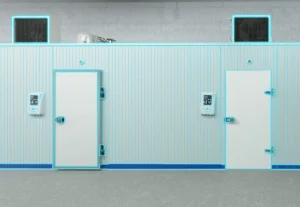
Hinged doors are one of the most common types of cold room doors. They operate like a standard door, swinging open on side-mounted hinges.
Design and Structure
Hinged cold room doors are typically constructed using insulated panels filled with polyurethane (PU) or polyisocyanurate (PIR) foam. They are sealed with rubber gaskets around the edges to ensure airtight closure.
The frame is usually made of aluminum or stainless steel to resist corrosion in cold, humid environments.
Applications and Benefits
Hinged doors are ideal for small to medium-sized cold rooms with moderate traffic. They are commonly used in restaurants, retail storage areas, and small warehouses.
Key advantages include:
Simple design and easy installation
Cost-effective solution
Reliable insulation performance
Low maintenance requirements
However, they require clearance space to swing open, which may not be suitable for tight or high-traffic environments.
Sliding Cold Room Doors
Sliding doors are widely used in commercial and industrial cold storage facilities where space efficiency and frequent access are required.
How Sliding Doors Work
Sliding cold room doors move horizontally along a track system rather than swinging open. This design eliminates the need for clearance space, making them ideal for narrow corridors or large openings.
They are often equipped with rollers and guide rails that allow smooth operation even in low-temperature conditions.
Applications and Benefits
Sliding doors are commonly used in large cold storage warehouses, logistics hubs, and food processing plants.
Advantages include:
Space-saving design
Suitable for large openings
Durable and heavy-duty construction
Better suited for high-traffic areas
They may require more maintenance than hinged doors due to their mechanical components, such as tracks and rollers.
Rapid Roll-Up Cold Room Doors
Rapid roll-up doors, also known as high-speed doors, are designed for environments that require fast access and minimal air exchange.
Design and Operation
These doors consist of flexible insulated PVC or fabric panels that roll up vertically into a compact housing unit. They open and close quickly, reducing the time the cold room is exposed to external temperatures.
Many modern systems include automation features such as motion sensors or push-button controls.
Applications and Benefits
Rapid roll-up doors are commonly used in high-traffic environments such as distribution centers, supermarkets, and cold chain logistics facilities.
Key benefits include:
Extremely fast opening and closing speed
Reduced air infiltration
Improved energy efficiency
Enhanced workflow productivity
These doors are particularly effective in environments where temperature stability is critical and frequent access is required.
Double Leaf Cold Room Doors
Double leaf doors consist of two panels that open outward or inward from the center, creating a wide access point.
Structural Design
Each leaf of the door is insulated and reinforced to provide strength and thermal protection. They are typically fitted with heavy-duty hinges and sealing systems to ensure airtight closure when closed.
Applications and Benefits
These doors are often used in large cold storage facilities, loading bays, and industrial freezers where oversized goods or palletized loads need to pass through.
Advantages include:
Wide opening for large equipment
Strong and durable construction
Suitable for heavy-duty operations
Good insulation when properly sealed
However, they require significant space for operation and are generally used in facilities designed for large-scale logistics.
Sliding Freezer Doors with Automated Systems
Advanced sliding freezer doors are often equipped with automation features to improve efficiency and reduce manual handling.
Automation Features
These systems may include motorized opening mechanisms, remote control access, and safety sensors that prevent accidental closure.
Some systems also integrate with building management systems for better control of temperature zones.
Applications and Benefits
Automated sliding doors are commonly used in pharmaceutical storage, cold chain logistics, and high-value food storage facilities.
Reduced human contact and contamination risk
Improved energy control
Enhanced operational safety
Seamless integration with automated systems
Specialized Cold Room Doors
In addition to standard door types, there are also specialized cold room doors designed for niche applications.
Glass Cold Room Doors
These doors are often used in retail environments such as supermarkets and display freezers. They allow visibility of stored products while maintaining insulation.
Fire-Rated Cold Room Doors
Designed for facilities that require both thermal insulation and fire resistance, these doors provide dual protection in high-risk environments.
Air Curtain Compatible Doors
Some cold room systems are designed to work alongside air curtains, which help reduce air exchange when doors are open. These are commonly used in retail and food service environments.
Choosing the Right Cold Room Door Type
Selecting the right cold room door depends on several key factors, including temperature requirements, traffic frequency, available space, and budget.
Facility Size and Usage
Small facilities often benefit from hinged doors, while large industrial operations typically require sliding or automated systems.
Energy Efficiency Requirements
Facilities with strict energy control standards should consider rapid roll-up or high-performance insulated sliding doors.
Operational Workflow
The movement of goods, equipment, and personnel should guide door selection to ensure smooth and efficient operations.
Conclusion
Cold room doors are essential for maintaining temperature control, energy efficiency, and operational performance in cold storage environments. With various types available—ranging from hinged and sliding doors to rapid roll-up and automated systems—each design serves a specific purpose based on facility needs.
Understanding the different types of cold room doors allows businesses to make informed decisions that improve efficiency, reduce costs, and enhance cold chain integrity. Selecting the right door system is not just a construction decision; it is a long-term investment in operational reliability and product safety.
Recent Comments